
Surprising fact: a failed login or a single lost seed phrase can cost as much as poor trade timing—yet most guides treat sign‑in as a checklist item rather than a security and access model. For US-based traders who use OKX for spot, margin, or derivatives, understanding how sign-in, custody, and wallet choices interact with trading tools is the difference between a resilient portfolio and one exposed to simple operational failure.
This article compares the primary ways traders access OKX—centralized account login versus the OKX non-custodial Web3 wallet—explains the underlying mechanisms that make each approach work, highlights likely failure modes, and gives practical heuristics for choosing the right path depending on goals (active trading, staking, DeFi use, or cold custody).
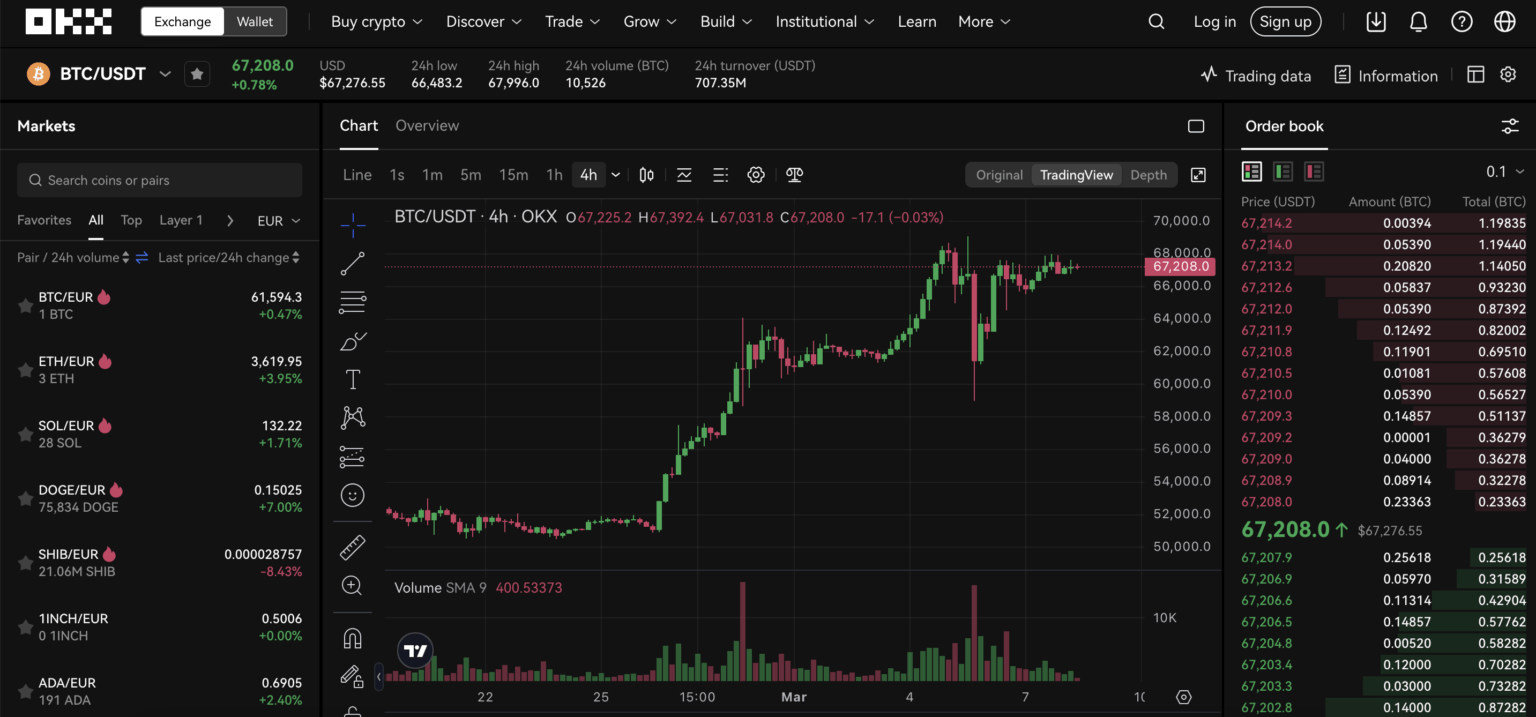
How OKX sign-in works: mechanisms under the hood
At a mechanical level, OKX supports two distinct access models that overlap but have different security and operational properties: a centralized exchange account (CEX login) and a non-custodial Web3 wallet. The CEX login is an identity-first flow: you create an account, complete KYC (ID + facial liveness for US users), and authenticate with multi-factor systems (SMS, Google Authenticator, or biometric on mobile). That account is linked to custodial balances: OKX holds your private keys for assets stored on the platform and uses cold storage and multi-signature approvals to secure withdrawals.
The Web3 wallet is the inverse: it is key-first. You generate a seed phrase and the wallet derives private keys locally; OKX provides the interface but not custody. You can use hardware integrations (Ledger, Trezor) and connect to DApps. Loss of the seed phrase equals permanent loss of access. The difference is more than semantics—it’s a trade-off between convenience+recourse and absolute self-sovereignty.
Side-by-side: CEX login vs. non-custodial wallet — trade-offs that matter
Think in terms of five decision dimensions: access recovery, security model, regulatory friction, product access, and failure modes.
Access recovery: CEX login wins. Because OKX stores most assets in cold, multi-sig systems (over 95% offline), account recovery through identity verification is possible if you forget your password. The wallet model offers no recovery except your saved seed or hardware device.
Security model: wallet wins for trust minimization. The Web3 wallet keeps private keys on the client side; attackers must compromise your device or trick you into signing a malicious transaction. The CEX relies on the platform’s defenses: military-grade encryption, AI-driven threat detection, and operational measures like Proof of Reserves which provide transparency that deposits are 1:1 backed. These systems reduce systemic risk but introduce counterparty risk: if exchange controls or internal procedures fail, you depend on OKX’s remediation.
Regulatory and KYC friction: CEX login requires KYC to comply with AML rules. For US traders that means ID + facial liveness checks before many features are usable. The non-custodial wallet avoids centralized KYC for on‑chain interactions, but note that bridging funds on/off the exchange will trigger KYC when moving into the CEX environment.
Product access: the best of both worlds often requires both. Margin, futures, and derivatives (up to high leverage like 125x for some futures) are CEX-native—these features generally require an account and KYC. Staking, DeFi yield farming, and the DEX aggregator are accessible via the wallet for on-chain strategies, while the CEX supports flexible staking and auto-compounding products for users who prefer custodial ease.
Failure modes: phishing and social engineering threaten both models but in different ways. For CEX accounts, credential theft and SIM swap attacks target 2FA; OKX’s AI detection mitigates but does not eliminate this risk. For wallets, malware and malicious dApp prompts that trick users into signing transactions are the core danger. In short: CEX = recoverable but trust-dependent; wallet = trustless but irrecoverable if you lose the seed.
Practical login and wallet workflow for US traders
Operationally, many experienced US traders use a hybrid flow: maintain an OKX CEX account for active trading and derivatives, and a separate non-custodial wallet for long-term holdings, DeFi experiments, or NFT activity. Move assets between them as needed, but treat each transfer as a security event—confirm addresses carefully, use hardware wallets for substantial transfers, and prefer withdrawal whitelists on the exchange.
If you sign in to your CEX account frequently, enable strong 2FA (an authenticator app or biometrics on mobile is preferable to SMS), register device fingerprints when available, and monitor session activity. For wallet use, write the seed phrase on paper and store in multiple geographically separate locations; consider a hardware wallet for large balances. Remember: OKX’s built-in Web3 wallet supports Ledger and Trezor, which turns a software wallet into a hardware-backed solution.
A closer look at security controls and limits
OKX’s infrastructure uses several layers: cold storage (air-gapped, multi-sig) for most assets, PoR for transparency, and AI-driven threat detection for logins. These are strong engineering controls, but they are not magic. Cold storage reduces the probability of mass online theft but does not prevent phishing or account takeover. PoR demonstrates backing at a point in time; it does not eliminate operational risk or liquidity squeezes if many users withdraw simultaneously under market stress.
Furthermore, interacting with DeFi via the DEX aggregator introduces smart contract risk. The aggregator sources routes from major DEXs—this can reduce slippage but links you to external contracts where exploits remain possible. The pragmatic trade-off: to earn higher yields through DeFi farming you bear smart contract risk; to earn staking rewards with custodial simplicity you accept counterparty reliance.
Delistings and platform hygiene: why it affects your login strategy
Exchanges regularly delist low-volume or risky pairs; OKX recently removed several spot pairs as part of routine pruning. For traders, this matters because pair availability affects where you hold assets and how quickly you can convert them into liquid markets. If you keep obscure tokens in your CEX account, a delisting could force an off‑exchange withdrawal or a conversion at a poor price. That nuance should influence whether you keep certain assets custodial or self-custodial.
Decision framework: which access model when?
Use this simple heuristic. If you need instant access to derivatives, margin, or high-frequency spot trading: favor the CEX account and harden it (strong 2FA, device whitelists, small custodial allocations). If you prioritize absolute control, DeFi yield strategies, or NFTs: favor the non-custodial wallet and layer hardware security. If you want both, partition funds: keep a short‑horizon trading balance on OKX and the rest in a non-custodial wallet with hardware backup.
What to watch next — signals that should change your setup
Monitor three near-term signals. One: regulatory changes in the US that affect KYC or custody rules—those can alter withdrawal speeds or product availability. Two: platform-level transparency updates such as changes to Proof of Reserves or custody partners—reductions in transparency should push risk‑sensitive traders toward self-custody. Three: ecosystem security incidents—smart contract exploits, exchange hacks, or large delistings. Each signal is actionable: increase liquidity buffers, move assets to hardware wallets, or rebalance across platforms.
FAQ
Do I need to complete KYC to sign in and trade on OKX from the US?
Short answer: yes for most actively traded products. OKX requires KYC (government ID + facial liveness) to comply with AML rules; this unlocks margin, derivatives, and many fiat on/off ramps. You can interact with on-chain features using a non-custodial wallet without centralized KYC, but moving funds into the exchange will trigger verification when using custodial services.
Is using the OKX Web3 wallet safer than keeping funds on the exchange?
It depends on what you mean by “safer.” The Web3 wallet reduces counterparty risk because you control private keys, so it’s safer from exchange insolvency or internal failures. But it exposes you to irreversible loss if you lose the seed or sign a malicious transaction. Custodial wallets are safer against human error in seed management and are recoverable via KYC, but they introduce platform trust and operational counterparty risk.
How should I set up 2FA and device protection?
Prefer app-based authenticators or biometric login on mobile over SMS. Register trusted devices, enable withdrawal whitelists, and use unique passwords managed by a reputable password manager. For large balances, combine custodial accounts with hardware-backed self-custody for the majority of holdings.
What happens when OKX delists a pair I own?
Typically the exchange will notify affected users and provide a window to trade or withdraw. Liquidity narrows after delisting, so plan for potential slippage. If you hold the token for non-exchange use (e.g., staking in a separate DeFi protocol), moving it to a non-custodial wallet before delisting preserves your options.
Final pragmatic takeaway: treat sign-in as risk architecture. Choose custodial access for speed and recoverability; choose self-custody for control and sovereignty; and, when you care about both, partition assets and enforce rigorous operational practices. If you want a quick primer on the web login steps and wallet options, OKX’s user pages and setup guides are a practical starting point—here is the official login guide to check exact UI steps: okx.